
Activity Outcome
Successful Conclusion of the Southern Taiwan Talent Training Session under the “Collecting and Writing Guidance Program for the National Hakka Village History Project (Phase IV)



- Source:客家文化發展中心
- Publication Date:2026/06/05
- Last updated:2026/06/05
- Count Views:391
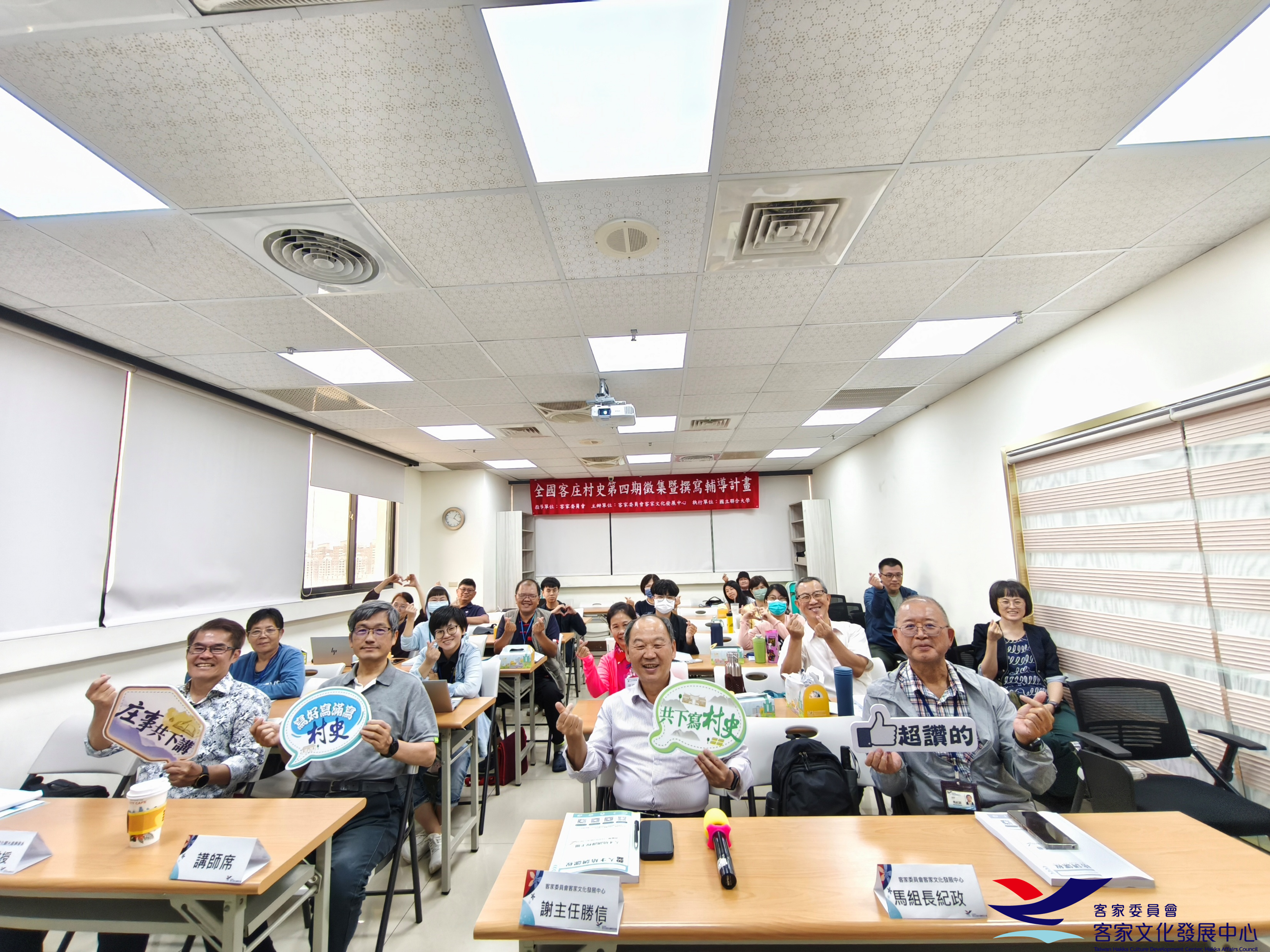
From April 24 to 26, the Taiwan Hakka Culture Development Center of the Hakka Affairs Council held the Southern Taiwan Talent Training Session under the “Collecting and Writing Guidance Program for the National Hakka Village History Project (Phase IV)” at the No.1 Conference Venue in Kaohsiung Station. The event attracted approximately 40 participants and featured a packed curriculum of 10 sessions, totaling 20 hours of instruction. Key topics included the fundamentals of village history, field research methods, writing techniques, academic ethics, and digital humanities.
A range of distinguished scholars and experts were invited to lead the lectures, including Professor Yang Chang-Chen, former Minister of the Hakka Affairs Council; Director Huang Yen-Ming of the Hakka Research Center at National Yunlin University of Science and Technology; Professor Wei Yen-Tsao, Department of Geography at National Taiwan Normal University; Professor Hung Hsin-Lan of the Graduate Institute of Hakka Cultural Studies at National Kaohsiung Normal University; Professor Wang Cheng-Wen of the Department of History at Tunghai University; Professor Wang Li-Jung of the Center for General Education at National Central University; Dr. Hung Yi-Mei of the Department of Computer Science and Information Engineering, College of Electrical Engineering and Computer Science, National Taiwan University; and Analyst Huang Wen-Yen of the Academic Publishing Department at Airiti Inc.
In addition to covering the core concepts for village history writing, the training placed a strong emphasis on practical application and proposal development, helping participants gradually build skills in field research, narrative structuring, and project proposal writing. Classroom discussions were lively and engaging, with participants enthusiastically sharing their own settlement experiences and local stories, demonstrating a deep commitment to preserving and documenting Hakka culture. Through these exchanges and discussions. These exchanges also highlighted the growing local demand for recording Hakka history and sustaining cultural heritage.
Village history writing is not only an exercise in compiling local histories but also an essential means of preserving and transmitting the cultural memory of Hakka communities. Through this training session, our center aims to equip more individuals interested in village history writing with foundational skills, and to support them in deepening their field research and writing during subsequent phases of collection and writing. Ultimately, the program seeks to gradually build a substantial collection of cultural documentation centered on Taiwan’s Hakka settlements. Looking ahead, our center will continue to promote related capacity-building and exchange activities, walking side by side with local writers as they work together to complete the documentation of Hakka village histories.